
Dear Friends,
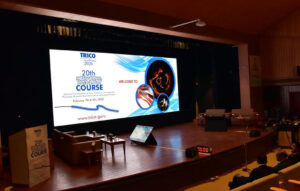
The 20th edition of TRICO — the TRanscatheter Intervention COurse — was held on 7th and 8th February 2026 at the Nirma University Auditorium. Completing two decades of TRICO is not merely a numerical milestone; it represents twenty years of uncompromising academic honesty, live transparency, and a shared commitment to learning without filters.
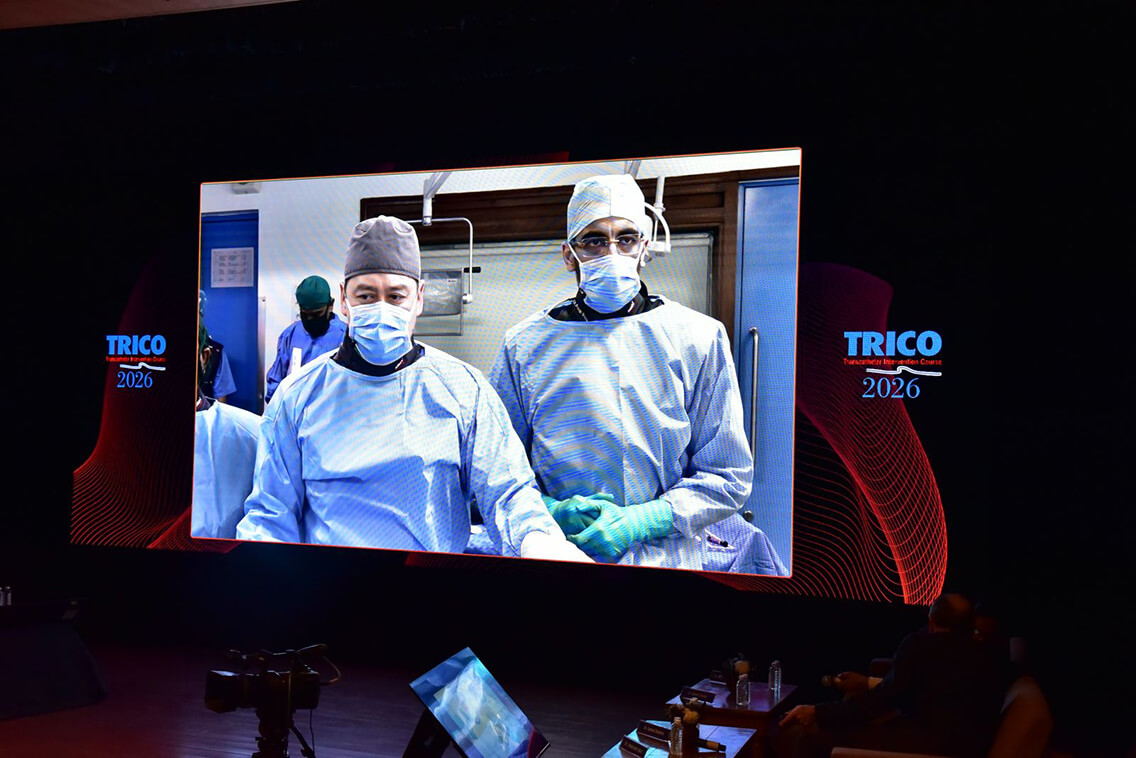
Nearly 400 delegates joined us this year. All live cases were transmitted from Apex Heart Institute through a dedicated secured cable network with high-speed backup connectivity to ensure uninterrupted broadcast. Behind every seamless transmission lies weeks of preparation and the disciplined effort of a team that believes in excellence.
We were privileged to host an outstanding international faculty whose presence enriched every discussion. Professor Takashi Akasaka from Wakayama Medical University, Professor Malcolm Bell and Professor Rajiv Gulati from Mayo Clinic, Professor Abdurashid Mussayev from the UMC National Research Cardiac Surgery Center in Astana, Dr. Kintur Sanghvi from Virtua Healthcare, and Dr. Samir Pancholy from Geisinger Commonwealth School of Medicine joined us in person and contributed immensely to the academic depth of the meeting.
It was personally disappointing that Dr. Shigeru Saito could not attend this year due to unavoidable reasons. Dr. Tak Kwan and Dr. John Coppola had graciously consented but were unable to travel. Their absence was sincerely felt.
TRICO 2026 was conducted in full compliance with updated directives from regulatory authorities, including the National Medical Commission and Supreme Court guidelines. Live education carries responsibility, and academic integrity must always align with ethical governance.
Case selection begins six to eight weeks before TRICO. We do not select cases for spectacle; we select them for substance. Each case must carry a clear educational objective — whether it challenges imaging interpretation, tests technical judgment, or demands composure under pressure.
This year, we curated fifteen live cases — two TAVR procedures and twelve complex coronary interventions — with a strong emphasis on IVUS, OCT, calcium modification, and physiology-guided decision-making.
Day 1 – Precision Under Pressure
We began promptly at 8:45 AM.
The first case was a heavily calcified LAD with circumferential 360-degree calcium and nodular disease. I performed the procedure with Dr. Sanjay Shah assisting at the table, while Professor Takashi Akasaka and Professor Rajiv Gulati moderated on-site. OCT guided every step of our strategy. We performed intravascular lithotripsy with 120 pulses, followed by high-pressure non-compliant balloon dilatation and drug-eluting stent implantation. Final OCT confirmed optimal expansion and apposition. The ensuing debate on calcium modification — IVL versus atherectomy — set the academic tone for the meeting.
The second case involved a patient with prior LAD stenting presenting with NSTEMI and critical left main bifurcation disease. Again, with Dr. Sanjay Shah assisting, we encountered hypotension and bradycardia during balloon inflation. OCT revealed complex plaque with calcific nodules extending into the circumflex. Under the moderation of Professors Akasaka and Gulati, and with active panel discussion involving Dr. Samir Pancholy, we proceeded with careful bifurcation stenting. The final imaging result was excellent. The transparency of hemodynamic instability and decision-making under pressure embodied the spirit of TRICO.
An RCA in-stent restenosis case followed, performed with Dr. Shah’s assistance and moderated by Dr. Samir Pancholy moderated by Professor Akasaka. OCT demonstrated neoatherosclerosis with heterogeneous and layered plaque patterns suggestive of TCFA. One segment was treated with a drug-eluting balloon and another with a drug-eluting stent. The exchange of perspectives, particularly regarding imaging interpretation, was intellectually stimulating.
Dr. Samir Pancholy then performed an IVUS-guided PCI to a complex RCA ostial stenosis, assisted by Dr. Aman Patel and Dr. Rajni. Professors Malcolm Bell and Professor Akasaka moderated the case, emphasizing IVUS-based optimization. Two stents were deployed with excellent final imaging confirmation.
A technically nuanced anomalous RCA case followed, which I performed with Dr. Shah assisting. After discussion with the audience and faculty, a hockey-stick guide catheter was selected successfully. IVUS confirmed a satisfactory result, reinforcing the importance of guide strategy in anatomical variants.
The structural segment of the day included a bicuspid aortic valve TAVR performed by Dr. Aman Patel, with Professor Abdurashid Mussayev assisting and demonstrating meticulous ultrasound-guided vascular access. Professors Rajiv Gulati and Dr. Kintur Sanghvi moderated the discussion. The procedure was executed in a stepwise and disciplined manner, culminating in an excellent final result.
Another important case involved unstable angina with a calcified LAD–diagonal bifurcation (Medina 1-1-1) in the setting of mild LV dysfunction. Although DK Crush and Mini-Crush techniques were considered, an alternative strategy was adopted. The diagonal branch was treated with a drug-eluting balloon, followed by LAD stenting under OCT guidance. Criss-cross rewiring and final kissing balloon inflation achieved optimal bifurcation geometry with excellent imaging confirmation. The case reinforced that bifurcation PCI must be individualized and guided by anatomy, intravascular imaging, and sound clinical judgment.
One of the most thought-provoking cases of the day involved combined imaging and physiology assessment of an ectatic anomalous RCA. Performed with Dr. Shah assisting and moderated by Professors Malcolm Bell and Takashi Akasaka, the case incorporated IVUS, OCT, and detailed physiological measurements including RFR, IMR, and coronary flow reserve using the CoroFlow system. The findings indicated significant microvascular dysfunction, and no stent was implanted. The debate that followed — particularly on the role of physiology in guiding restraint — was among the most enriching discussions of the course.
Day 1 concluded with faculty and delegates gathering for a gala dinner, strengthening bonds beyond the cath lab.
Day 2 – Judgment and Discipline
The second day began with a valve-in-valve TAVR performed by Dr. Aman Patel with Professor Mussayev assisting. Moderated by Professor Rajiv Gulati and Dr. Kintur Sanghvi, the degenerated surgical bioprosthesis was successfully treated, and high-pressure post-dilatation achieved optimal valve expansion with negligible gradient.
A complex LCX-OM bifurcation was then addressed using a classic mini-crush technique, which I performed with Dr. Shah assisting. Professors Malcolm Bell and Takashi Akasaka moderated the case. OCT-guided optimization ensured an excellent final result, and the discussion centered on bifurcation strategy selection.
Perhaps the most demanding case of TRICO 2026 was a heavily calcified LAD extending into the left main. Imaging revealed extensive calcium beyond angiographic appreciation. With Dr. Shah assisting and Professors Akasaka and Bell moderating, orbital atherectomy was undertaken. During the procedure, the patient became unstable and the LAD occluded. Rapid re-crossing restored flow. Imaging confirmed effective lesion modification without dissection. A thoughtful debate followed regarding ostial stenting, and ultimately a conservative strategy was chosen. This case demonstrated that judgment, not aggression, defines excellence.
Academic Sessions
The didactic program featured twelve focused lectures delivered by our distinguished faculty. Professor Malcolm Bell addressed radiation safety, Professor Rajiv Gulati spoke on complex coronary aneurysms, Dr. Samir Pancholy discussed stent expansion optimization, and Dr. Kintur Sanghvi presented on renal denervation. National faculty contributed sessions on interventional pharmacology and evolving techniques. The auditorium remained engaged until the final lecture — a reassuring sign of intellectual curiosity.
Final Reflections
TRICO 2026 was not simply a meeting. It was a reaffirmation of what live education should represent — transparency, rigor, debate, and responsibility.
For twenty years, TRICO has stood for teaching not only how to perform procedures, but how to think, interpret, analyze, and decide under pressure.
I extend my sincere gratitude to our confirmed international faculty, national faculty, delegates, industry partners, and the organizing team who made this 20th edition memorable.
TRICO 2027 will be held on 13th and 14th February 2027.
We will continue to question.
We will continue to learn.
We will continue to evolve.
With warm regards,
Professor (Dr.) Tejas M. Patel
Course Director, TRICO
Apex Heart Institute, Ahmedabad